Save the Economy with More Exercise, More Showers, Longer Commutes

Banking Hours?

Do you have certain hours of the day when you are most creative? People always say they get ideas while showering, exercising, or commuting. If these are indicators for creativity, I wonder which countries have the great environment for generating ideas?

I don’t know who takes the longest showers, and does the most exercising but there are numbers available for longest commute. According to Worldmapper The world average commute is an hours and twenty minutes each day and the nation with the greatest commute time is Thailand with over 2 hours. In fact, Southeast Asia, on averaged commutes almost twice as long as workers in North America. Bad for fuel consumption, pollution, and productivity but is it good for generating ideas?

Do you think urban or suburban commuting makes a difference and which is more conducent for generating new ideas: Mindless driving? Or being a passenger in a taxi and letting your mind wander?
Here is an innovation: for Fashion Week, A fleet of 50 taxis in New York City are providing free rides to test a new service. The already equipped in-taxi TV screens will be used for this experiment to allow passengers to view advertisements and make direct purchases of items, like lipstick, by scanning a code with their mobile phones.

Apparently, a supermarket has tested this idea in Seoul allowing passengers to buy groceries (for delivery) directly from billboards in their wifi enabled subways. This could certainly revolutionized and expand the concept of what is a store, if anything printed with a barcode becomes an opportunity to buy and sell. But will it give us more to do during our commute and take away our precision time to daydream?10 Comments

Share

Is it a MISTAKE to be comfortable with FAILURE?

Time to celebrate?

Failures cost us virtually nothing when we take photos with our digital cameras, yet failures cost us plenty when our banks make bad loans. Our political leaders fail us when the only agreement they reach is raising our debt ceiling allowing themselves to continue spending.

We hear that our creative spirit can save us all and according to conventional wisdom, to innovate we need to take fearless risks and be open to: “fail now,” “fail today,” “fail this afternoon,” ”fail tomorrow,” “fail often.” A recent Wall Street Journal headline reads
Better Ideas Through Failure: Companies Reward Employee Mistakes to Spur Innovation, Get Back Their Edge.

I wonder if even George Eastman would have thought failure has become overexposed. Are we producing an entrepreneurial culture or a culture of failure? Are we getting too comfortable with failure?

Of course we don’t expect to paint a masterpiece the first time we walk across a stage, and we shouldn’t be afraid of trial and error. Are we justifying and celebrating too many of our errors as we say: “At least I got the interview,” “it was an honor to be nominated,” “what a great experience,” “I met so many interesting people,” or “we designed a great product that was ahead of its time.” In our winner take all society; ask Al Gore, barnesandnoble.com or yahoo what second place is like. Remember that we can learn from our successes too!

Winning isn’t everything. The will to win is the only thing.” described Vince Lombardi in an earlier era. In our acceptance of some inevitable failures, we can’t lose the will to win! Winning is the only option when the game is on, and only after the whistle blows can we allow for acceptance of failure and lessons learned. If you go into a supermarket expecting that you won’t find Key Limes, you probably won’t. When we expect failure, we give up too soon.

Your secret plan

  1. Start without concern about failing.
  2. Play to win! And failure is not an option!
  3. Evaluate your wins or losses for learned lessons.

What was your biggest mistake that you used to make a towering success? Or what is your biggest success and what did you learn?
8 Comments

Share

Original Copies or Original Sins?

Seeding our clouds for a rainstorm of ideas

Seeding our clouds for a rainstorm of ideas

Like dialing your rival at the same moment they try to dial you, Alexander Graham Bell invented the telephone at the same time as Elisha Gray. Bell got to the patent office first and legally received the credit and fame, but were they both being original? It’s your call?

A certain number of people read the same news, watch the same movie, face the same problem and have a collective ah-ha moment to offer a collective solution. You could be thinking of a “new” idea and unbeknownst to you, somebody on the other side of the globe is thinking the same thing. It’s discouraging to come up with a “original” idea only to enter a few keywords into a search engine to find others are already standing in the same space.

Paul Bloom described in a TED  talk how especially in the arts, we appreciate originals more than copies. He tells how a once admired masterpiece lost its value when it was discovered to be forged and how a gifted violinist, who was appreciated in concert was largely ignored when anonymously playing at a train station.

What can you to do to be original? As you are saturated with information, does too much stimulation prevent you from being original? A talented artist and prolific writer Val Erde recently asked the good question: “I do think that the more I’m on the internet – certainly with my habit of always filling up my mind with stuff I read on it – the less creative I am in terms of originality. Does it affect you the same way?”

Original and salt free

Original and salt free


Of course we are all influenced by our environment. Filling our heads with the latest thinking on subjects is like seeding our own clouds for a future rain storm of ideas. Everything we do is done in our own way and is somewhat original.

Some people believe that art is a reflection of our environment and culture -so as the kaleidoscope of our world changes, so does what we produce. Don’t worry so much if someone else is doing something similar – do your own thing and soon your brief overlaps will dissipate.

“Yes, one may make mistakes, one may perhaps exaggerate here or there, but the thing one makes will be original. You have read in Rappard’s letter the words: “I used to make things now in this, then in that style, without sufficient personality: but these last drawings have at least a character of their own, and I feel that I have found my way.” I feel almost the same thing now.” described Vincent van Gogh to his brother Theo, c. 22 June 1883

We all have a unique experience and we all express things differently – as you put some words together, draw some lines, or dance, it’s possible someone else has done this before but when you add your own context and write a paragraph, paint a picture, dance a number, then it’s likely to say that this hasn’t been done exactly the same way. Does awareness of others increase or decrease your originality?

10 Comments
Share

Live Longer by Eating, Drinking and Relaxing: 2 Books 2 Save Your Life

No time to be a crab.

John Belushi, Jim Morrison, Wolfgang Amadeus Mozart, Vincent Van Gogh… unfortunately the list goes on and on – what else could they have created if they had lived longer? If you cut out some of your vices, does life become longer or does life just seem longer?

Today, the number of centurions is growing by 7 percent a year. Will you be one of them someday? For a living history, talk with one and learn how they adapted to a world that changed from long trips on horse and buggies to long waits at the airport, from silent movies to cell phones with streaming ads, and from deciphering Morse code to miscommunicating by SMS texting.

The greatest innovations weren’t air conditioning, TV remote controls, or microwave popcorn as many suspect, but instead came from improved health and nutrition that actually kept us alive and increased our life expectancy.

Thankfully, we no longer have to worry about being eaten by dinosaurs, falling out of chariots or freezing in an ice age, and OSHA standards have reduced workplace accidents to mostly paper cuts and burning our lips on coffee, but will our life expectancy continue to increase with our seemingly poor diets and increased stresses? While technology focused on making things convenient, and marketing focused on making things affordable, has anyone been concerned with our well being?

Sometimes we have to take matters into our own hands. Although they are no spring chickens themselves, here are two books that can help you to live happily ever after. the Relaxation Response by Herbert Benson M.D., shows how an easy to learn and simple to practice form of meditation can reduce your stress and reduce a host of nasty physical ailments.

The second book was given to me as a present and became a true gift. In general, the medical community has a predisposition to prescribe drugs and the Department of Agriculture has a mission to promote farmers. Who has the incentive to promote your longevity? Not the governments who pay out entitlements, the answer is YOU. In Eat Drink and Be Healthy
by Walter C. Willett, MD, the author provides practical advice about remaining healthy that is designed to enrich your body instead of enriching special interests. Both books have a long shelf life and I won’t spoil the endings.

When I was packing to move to Hong Kong, I sent thousands of my books into storage, but these are two books I brought along. What books would you bring to a tropical island?
What books will you share that you think could help others stay healthy?
10 Comments

Share

Catching Ideas in Buckets

晴耕雨読 seiko udoku : Farm when it's sunny, read when it rains.

晴耕雨読 seiko udoku : Farm when it's sunny, read when it rains.

Sometimes the tides deposit millions of beautiful seashells on the beach and sometimes they wash up only a few broken shards. Have you found that generating ideas is also unpredictable and seems to ebb and flow?

Have you been hungry and wandered around having a difficult time searching for a suitable restaurant and after finding one and eating, you notice on the way home, three more good possibilities. Have you felt indecision when being helped by a pushy salesperson until you say: ”I’m not going to make a decision today.” Then with the pressure turned off, your blood pressure drops, your head clears, and you feel confident to make a purchase.

Sometimes pressure creates necessity, sometimes it creates diamonds, but often it causes anxiety. Are you more creative under pressure with deadlines looming or when relaxed? Not sure what to paint or write? Not sure how to solve a problem? or what to do on a rainy Sunday? When you finally get an idea, the pressure is off, you relax and your mind generates a thunderstorm of new ideas. Too many to use – so catch them in buckets! And write them down for next time. Even if you don’t use them, they can kindle new thoughts.

There is certainly a lot of pressure to develop solutions in Japan today. The kind of pressure most of us would be fortunate to never have to face. To solve the problems – wishing the Japanese buckets of useful ideas! 6 Comments

Share

Jet-Fresh Ideas

jetfresh

Not exactly a jet

Have you ever been in some far flung places and noticed food being labeled as “Jet-Fresh?” If you search for a formal definition at dictionary.com you get: “No results found for Jet-fresh,” and it’s politely suggested: “Did you mean Catfish?”

Relying on experience, Jet-Fresh seems to mean produce or flowers that are freshly picked, immediately packed on ice, and rushed by limousine to the airport where the “catfish” are flown by private plane to you, all in a carbon neutral manner.

I would like to coin a new definition for Jet-fresh to mean: “A brand new idea – borrowed from a place far away.” New ideas are everywhere and so many of our ideas come through travel.  We don’t even have to go too far to hear different points of view and see different ways of doing things. Online, it’s as easy to read a foreign newspaper or twitter posts that originated in other parts of the world than it is to read what is local. Not only is food fusing but ideas are too and some of the good ones are Jet-Fresh.

“I can’t understand why people are frightened of new ideas. I’m frightened of the old ones,” said composer and philosopher John Cage.  Some old ideas, like catfish shipped on a slow boat, can be frightening. What was the latest idea you came across that was Jet-Fresh? 14 Comments

Share

Survival of the Fittest?

Yellow Orchid

Not in my backyard

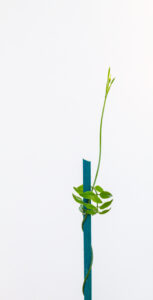
There is an ancient vine growing on a trellis in my backyard. Each spring, some runners reach up for the stream of water that runs along the gutter and each summer, I prune the vines off the roof. It occurred to me that for the sake of order, I was cutting the longest, strongest, and most adaptive stems, and although the plant survives, I’m discouraging the plants full potential and may be missing the best flowers.

Forbes asks: Are people too smart to be creative?
Companies can’t have too many captains and can’t have too many stray vines. Employees are encouraged to keep the status quo and stay aligned with company goals. How do you remain professional without sacrificing creativity? Understanding the mission, adhering to culture, dress, using proper language, grammar, being on time, and keeping to schedules all help your ideas to be accepted without sacrificing your creativity. Bounce ideas off trusted friends before making them public. Look for the formal or informal paths for innovation that allow for review and selection of new ideas worth implementing.

Understanding culture and paths for innovation allows you to climb the trellis and flower without being clipped. How do you create within an organization?

1 Comment
Share

Best of the Best – Your Second Chance

Lion Dance Sheko

Lion Dance: King of the Jungle?

新年快乐! Kung hei fat choi! As China welcomes the year of the rabbit, westerners have a second chance to make a New Year’s resolution and may I suggest something of global proportions.

There is talk of countries using creativity to increase competitiveness through innovation. That’s fine for whole countries but what about us? Individuals are also starting to look around and realize they are not the only ones running the race.  What steps can we take to become personally more competitive?

Although globalization has fans and opponents, it’s nothing new and has been around since before the Phoenicians sailed the Mediterranean or caravans traveled the Silk Road.  Today’s phenomenal growth in the East is partially the result of centrally planned capitalism, for example, China has thrived by looking at their strengths, weaknesses, opportunities, and threats (SWOT) and using this to target industries to put their resources.

Year of the Rabbit (SWOT Analysis)


Strengths


Weaknesses

Cute, Fast, Soft

Small

Multiplies

Poor Language Skills

Four Lucky Feet

Damages Gardens

Excellent Hearing

Owns Easter

Bugs Bunny Franchise

Opportunities

Threats

Silent Spokes-model

Foxes

Entertainment

Wile E. Coyote

Gaming

Competition from:

Pets

Dogs and Cats

Surveillance

Fur Coats

It’s no longer good enough to be the best rabbit on your block or your neighborhood, today; we must be the best in the world. What steps do you need to take to get in the top 1 percent of people within your skill set. We can start by asking what do like to do? What am I especially good at? Where do I add the most value?

List a few things by asking: What do I need to do to get on next year’s top ten list? How do I win the gold medal in cost accounting? What do I need to do to win the Oscar for most efficient software coding, or the daytime Emmy for most positive influence on children, or the people’s choice award for most caring of my patients, or the best supporting customer service rep? Think about what business you are really in – Apple is not in the computer business but information sharing.

Find the best teachers and first-class partners. Find the intersection between your chief skills and your collaborators unique abilities. If we happen to be the best auto mechanics and team up with a great farmer, maybe our competitive advantage comes from improving tractors.

Being the best in no longer about vanity or bragging rights, it’s about survival.  If you take steps to identity and refine your skills now: “You’ll be best of the best. Wherever you go, you will top all the rest,” as Dr. Seuss said. 3 Comments

Share

Your Space and Time

Not yet sunset.

Not yet sunset.

Where do some of your best photographs come from? When traveling, after we arrive at our destination, everything is new and we capture our first impressions. After staying for a while, our perceptions deepen and we notice things we never would have on first glance.

After spending a week in Krabi, I learned the terrain and how to take advantage of local weather and lighting conditions. Even after a short time, our perception develops.

We prize child prodigies for their gift and honor young artists or writers for seeing things in a new way, but you can almost hear Rod Stewart singing: “I wish that I knew what I know now. When I was younger.” What if we approached subjects armed with a lifetime of experiences and a deep understanding of the world and human nature? Wouldn’t this give us more tools to be creative?

“The normal adult never bothers his head about spacetime problems. Everything that there is to be thought about, in his opinion, has already been done in early childhood. I, on the contrary, developed so slowly that I only began to wonder about space and time when I was already grown up. In consequence, I probed deeper into the problem than an ordinary child would have done” explained Albert Einstein.

Whether or not they started as tots, many creative people made their greatest contributions latter in life using  seasoned approach to produce profound innovations. Every time you look at the same painting or watch the same performance, you see it differently base on your accumulation of experiences. What long settled assumptions will you revisit with the eyes of experience?
9 Comments

Share

New Fruit on an Old Tree

Heirloom

Heirloom

I read the news today oh boy; with much fanfare, the Beatles released the digital versions of their music on iTunes. This is big release for 40 years ago albums. While most music made it to the web a digital lifetime ago, the holdup was related to a long trademark dispute over the ownership of the apple with both the Beatles’ Apple Corp and Apple Computer each wanting a bite. The questions for us to consider are what makes: She Loves you, Yellow Submarine, and Help! endure? And are there  common elements that we can incorporate into what we make?

They were hot in the 60s and their upbeat and enjoyable harmonies, catchy lyrics with timeless messages are some of the reason why the Beatles remain relevant today. Some songs hold up because they remind us of yesterday, but most of these songs hold up because they still remind us of today.

Now that we’re comparing oranges to oranges, what factors have allowed Apple Computers to not only endure but to be getting so much better all the time. People fondly remember the old Macintosh but left unchanged, few would use an antique computer today. While some computer makers concentrated only on increasing processor speed, Apple stayed relevant and ahead of the competition by continuously innovating their products in ways that improve the user’s experiences. Constantly improving their own products, if something works, they don’t just let it be.

1 Comment – how do you like those apples?

Share