• Skip to primary navigation
  • Skip to main content
  • Skip to primary sidebar
  • Facebook
  • RSS
  • Twitter
  • YouTube

Courageously Creative

Be more creative in your own way

  • Home
  • FAQ
  • About
  • David’s Artwork
  • Blog
    • Creating
    • Inspirations
    • Innovation
    • Competitiveness
    • Food
    • Risk taking
    • Painting
    • Future
  • Book

Sharonomics – You Heard it Here First

May 25, 2011 By David Goldstein

sandwich

Wanna bite to share?

Oprah Winfrey said “it’s not just about being able to write a check. It’s being able to touch somebody’s life.”  Rockefeller, Melon, and Carnegie used innovation to amass unimaginable fortunes. Later in life they used their fortunes for the betterment of society, and blazed a path that Warren Buffet and Bill Gates are following today.

Although few of us have amassed incredible level of wealth but we all have an abundance of something valuable to give back. Sharonomics is a new word I created and defined as follows:

SHARONOMICS (Share – ON- Omics)
1) Form of philanthropy for the information economy that involves the distributing of accumulated knowledge and experiences to where they can do the most good.

From your lifelong experiences, what troves of wisdom have you collected that have served you well and now can be shared to benefit others? Did you drink from the purest streams? Did you seek the finest teachers, read the best books, travel to the most magnificent locations and strive for unique experiences? WHAT are you going do with all of this rich data that you collected?

My challenge is for you to find creative ways to share your wisdom as a teacher or a mentor. Look for opportunities to use your unique abilities to reach and teach others. Not by divulging your valuable intellectual property but by sharing your wisdom to empower others, reduce suffering and make the world a better place.

Finding the place your ideas will do the most good is part of the challenge. “I resolved to stop accumulating and begin the infinitely more serious and difficult task of wise distribution,” described Andrew Carnegie. You may have a few pieces of a puzzle in your pocket or some  spare parts on your workbench that are useless to you, but can solve someone else’s problems. You may have some ideas that don’t have much use in your hands but can empower someone else. Try to identify other’s needs and place your ideas into their hands.

There was a time when our collective knowledge was passed through generations by word-of-mouth. Later, apprenticeships were common for teaching trades and crafts. Artists have always shared their ideas through what they create. Today there are plenty of new media outlets like Wikipedia where volunteers transfer information to the next generation, and if you can cut through the noise of twitter, you can share specialized knowledge, but do we take it for granted that our important values, techniques and life lessons are reaching the optimum audience.

Henry Ford said “Time and money spent in helping men to do more for themselves is far better than mere giving,” but is it the time and money that helps or the shared ideas that provides empowerment? Most of us don’t have surplus time or extra money to give but we do have expertise. Look for ways to share your expertise and the world will be a better place.

Are there ways that you are sharing that you would like to share?
Live Longer by Eating, Drinking and Relaxing: 2 Books 2 Save Your Life

May 12, 2011 By David Goldstein

No time to be a crab.

John Belushi, Jim Morrison, Wolfgang Amadeus Mozart, Vincent Van Gogh… unfortunately the list goes on and on – what else could they have created if they had lived longer? If you cut out some of your vices, does life become longer or does life just seem longer?

Today, the number of centurions is growing by 7 percent a year. Will you be one of them someday? For a living history, talk with one and learn how they adapted to a world that changed from long trips on horse and buggies to long waits at the airport, from silent movies to cell phones with streaming ads, and from deciphering Morse code to miscommunicating by SMS texting.

The greatest innovations weren’t air conditioning, TV remote controls, or microwave popcorn as many suspect, but instead came from improved health and nutrition that actually kept us alive and increased our life expectancy.

Thankfully, we no longer have to worry about being eaten by dinosaurs, falling out of chariots or freezing in an ice age, and OSHA standards have reduced workplace accidents to mostly paper cuts and burning our lips on coffee, but will our life expectancy continue to increase with our seemingly poor diets and increased stresses? While technology focused on making things convenient, and marketing focused on making things affordable, has anyone been concerned with our well being?

Sometimes we have to take matters into our own hands. Although they are no spring chickens themselves, here are two books that can help you to live happily ever after. the Relaxation Response by Herbert Benson M.D., shows how an easy to learn and simple to practice form of meditation can reduce your stress and reduce a host of nasty physical ailments.

The second book was given to me as a present and became a true gift. In general, the medical community has a predisposition to prescribe drugs and the Department of Agriculture has a mission to promote farmers. Who has the incentive to promote your longevity? Not the governments who pay out entitlements, the answer is YOU. In Eat Drink and Be Healthy
by Walter C. Willett, MD, the author provides practical advice about remaining healthy that is designed to enrich your body instead of enriching special interests. Both books have a long shelf life and I won’t spoil the endings.

When I was packing to move to Hong Kong, I sent thousands of my books into storage, but these are two books I brought along. What books would you bring to a tropical island?
What books will you share that you think could help others stay healthy?

No Children Were Harmed in The Making of This Mother’s Day Card

May 4, 2011 By David Goldstein

Made by hand or by foot?

We all did it in preschool, some of us in camp, but when was the last time that you made a greeting card by hand?

My mom always encouraged my creativity and whatever I made, she always said something overwhelmingly positive and always uses the word “BEAUTIFUL!” As a child, her praise was so loud that while many other kids became discouraged away from art by criticism, I was insulated.

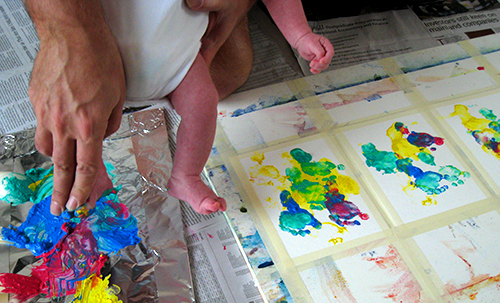
Everyone has only one mom but you can send more than one card. Every year I made Mother’s day cards for my mom, wife, mother-in-law and grandmother. My favorite was a collaboration (pictured) with my son when he was only one month old. Pouring a set of washable finger paints on a tinfoil palette, I used his miniature foot as a stamp. He was not pleased but not harmed either.

Making Mother’s day cards is the one time of year that I paint flowers. One year, when I was living in Tribeca, I found some tulips growing in Hudson River Park. As I was painting them a class of toddlers came by and their teacher said that the children planted the flowers from seeds. The kids were happy to see me painting their subjects, and being all experienced watercolor artists and card makers themselves, we had a sophisticated discussion about techniques.

Mother’s day is this Sunday and there is still time to make a card. You don’t need anything fancy. Get a sheet of paper, fold it into four and draw, paint or paste something that you think your recipient will appreciate. Then, just write something nice on the inside. In today’s world of e-cards, don’t be surprised if your real paper card ends up hanging in a frame. Beware that once you start making cards, you raise the bar for next year.

What memorable cards have you received or what were your favorite cards you made?

Perfectly Off Balance

April 20, 2011 By David Goldstein

balanced

Small sailboat provides balance

When something is off balance, you notice right away: too much coriander in the curry, the picture hanging over the fireplace is crooked, or the volume in the left speaker is too low. You adjust and like fixing a wobbly table, you mentally stack sugar packets under a leg to set things right.

We learned to balance our seesaws, bicycles and check books but sometimes balance doesn’t have to mean equal. Look at the photograph and use your finger to cover the sailboat in the upper left corner. Without that tiny speck of white, the much more massive plants and flowers look off balance.

On a recent trip to the British Virgin Islands, I heard a surf instructor tell his student: “balance is not always gained by standing in the middle of the board.” Shortly later, someone handed me a Zen card with the words:

“The center is not always the point of balance”

And all of a sudden a lot of things made sense. Achieving balance does not require equal, opposite or symmetrical forces. Leverage can be used to balance the small with the large. Sometimes one cute habanero pepper can balance an entire pot of gumbo or a holiday weekend can balance a five day work week.

Equilibrium spans many disciplines but for art – shapes, colors and lines are arranged to produce a whole that is harmonious and pleasing. Talking about balance got Henri Matisse in big trouble when he said: “What I dream of is an art of balance, of purity and serenity devoid of troubling or depressing subject matter – a soothing, calming influence on the mind, rather like a good armchair which provides relaxation from physical fatigue.” The critics banished him for creating “decorations” instead of serious artwork. Who would want some of those decorations now?

Sometimes we just have to step away from the middle to find our true balance. What do you think?

Is One Night in Bangkok Enough? Using the Rule of 10 to Double Your Experience

April 7, 2011 By David Goldstein

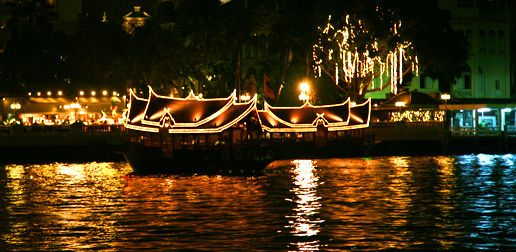
TravelogOne reason we travel is to gain inspiration. We take in the sights and smells, clear our minds, and begin to see things differently – But we are all short on time, so how long does it really take to absorb our surroundings?  And does anyone really need to spend more than one night in Bangkok? To determine the answer for yourself, I’ll give you my secret formula.

Travel is unpredictable. I’m probably the only person to have ever woken up one morning without knowing that by the end of the day, I would be going to sleep 6,000 miles away in New Zealand. Even though I left Auckland the next morning, I still remember my first impressions.  Have you found that when you visit a town for a night or two and keep your eyes open, you can get a real sense for a place that you never would have from any other way? What do you remember from some of your shortest visits?

In order to double your understanding beyond your initial impressions, try to stick around for ten days, meet some local people, and get immersed in some kind of activity. I’ve learned more about the Caribbean people from trying to get a flooded underwater camera repaired at the harbor than I ever did from other travelers on a dive boat.  What events have caused you to learn something unexpected from spending 10 days in a foreign location? The rule of ten follows and another doubling of knowledge comes after the first 100 days -think about the last time you moved to a new home, did it take about three months to get mostly settled?

If you are logarithms enthusiast, you may appreciate the name I gave to this phenomenon “the Log of Travel,” which states: To double the value of your initial experience, you need to increase the duration of your stay by 10.

As the moss begins to grow, there are fewer novelties and it takes longer to get much of a gain. The next doubling  takes about three years, and may involve  finding a job, making some friends, and subscribing to the local paper before we can reach another plateau. After that, I have not tested this on mice, but I suspect the next doubling  will probably take three decades. Maybe this is the amount of time it takes to truly master your craft too. To truly get inspired, talk to a centenarian, but that’s another story.

Everyone says to travel to gain new inspirations – but few think about the effect of the length of their stay. Please double check my math and comment about how travel has inspired you!

Stepped on a Pop-Tart?

March 30, 2011 By David Goldstein

Searching for the lost shaker of salt

On a friend’s junk somewhere in the South China Sea, Margaritaville was playing and Jimmy Buffet was singing the line: “stepped on a pop-top.” Some of the younger guys on the boat were wondering, how could anyone step on a pop-tart? Did a frosted raspberry tart fly out of the toaster?

Those kids happened to be drinking TsingTaos and the very strange coincidence was that the cans must have come from an old bottling line since they actually had pop-tops. When was the last time you wedged your finger under the aluminum ring to pry off one of those tabs – and hopefully you didn’t toss it on the ground but “put litter in its place” or did you try to crochet with them?

Well, no sooner did I explain what pop-tops were, and how we had to watch for them when walking barefoot on the beach, when a young woman limped up to us in pain with one embedded in her heel. Pop–tops may not be around much anymore but some things don’t change.

A week later, Blondie performed at a fund raising gala, but before she could sing “Call Me,” she had to explained  to the young people: “what a phone booth was.” When was the last time you saw a phone booth? This started to become a theme – it was quaint to see Sting in Macau singing “if the Russians love their children too,” long after the cold war ended and now that we’re all practically family – conversely, Rod Steward and Harry Connick Jr., singing about love seem timeless and how could the Black Eyes Peas Elephunk ever be dated. Walt Disney said “Fantasy, if it’s really convincing can’t become dated for the simple reason that it represents a flight into a dimension that lies beyond the reach of time.”

Furthering an idea from an earlier post: “Some songs hold up because they remind us of yesterday, but most of these songs hold up because they still remind us of today. When we create we make references to our surroundings. The moment we mention any form of technology or current event, our work gets a large purple date stamp – does anyone besides election or immigration officials in developing nations still use rubber stamps and ink pads?

When you create, is it your intention to make a historical record? Does adding contemporary references either make obsolete or immortalize what you make? Do you sense fleeting moments and want to capture them? And are we even conscious of the choices we make of what we include in our songs, paintings, stories or what we decide to add to our photo albums?  Or what is your favorite song with lyrics that are out of date??

  • « Go to Previous Page
  • Page 1
  • Interim pages omitted …
  • Page 6
  • Page 7
  • Page 8
  • Page 9
  • Page 10
  • Interim pages omitted …
  • Page 13
  • Go to Next Page »

Primary Sidebar

Creative You ORDER NOW:
amazon
Barnes and Noble

Sign Up For Our Newsletter

Subscribe to the Blog by Email:

Archives

RSS Creativity, Innovation News

  • Art LANDMARK brings innovative partnerships and creative discourse to the center of Central - prestigeonline.com
  • World Creativity and Innovation Day: In the Age of AI, What Makes Art Meaningful? | Newswise - Newswise
  • World Creativity and Innovation Day: In the Age of AI, What Makes Art Meaningful? - Dailyhunt
  • San Francisco Art Fair 2026 Explodes with Global Creativity and Bold Innovation at Fort Mason Center, USA - Travel And Tour World

Copyright © 2026 · Privacy